INSIGHT
The Agentic Organization
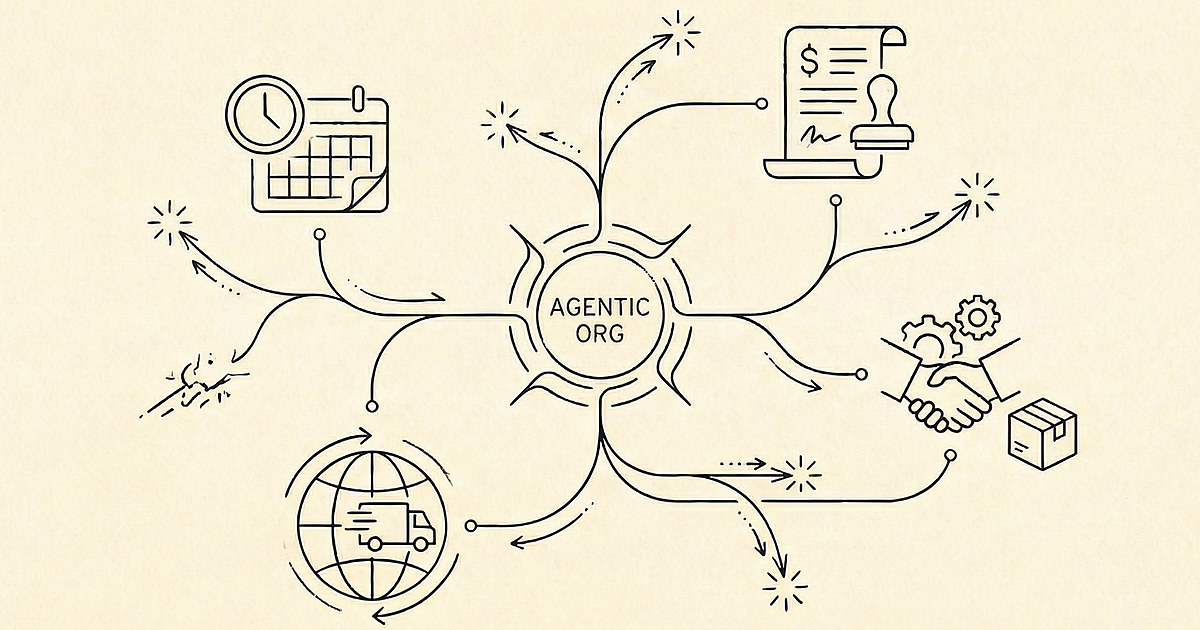
The Agentic Organization
An email arrives at 9:03 AM announcing a supplier delay. By 9:07, your organization has assessed the impact, identified three alternative suppliers, sent pricing requests to each, and drafted a revised project schedule. No human has touched it yet. This is not a future scenario. This is what an agentic organization looks like today.
The Concept
The concept of an agentic organization is the idea that most of the operational processes of a company—over time, basically all of them—will be performed by agents and agentic systems. This is not a marginal efficiency gain. It is a fundamental change in what an organization is: from a collection of people coordinating through communication, to a system of agents executing on a shared representation of the business, with humans directing strategy and handling exceptions.
This is not science fiction; this is very much possible today. One of the biggest blockers is sufficient context and integrations so that agents can truly understand an organization, understand its needs, and execute on those needs.
Why Now
Two shifts make this possible now: AI agents capable of reading, reasoning, and acting on unstructured information, and a dramatic drop in the cost of custom software development—making bespoke business systems achievable for companies of any size.
Building integrated systems used to require expensive enterprise software—vendor solutions built for general cases, with long implementation timelines, ongoing licensing costs, and inevitable compromises where the software didn’t quite fit your processes. The age of AI changes this equation. Not only can agents do the operational work, but the cost of building custom software has dropped dramatically. A company of almost any size can now build one-of-a-kind software that exactly represents how they do business—not too much, not too little—and evolve it as their needs change.
The Status Quo
Take an example from the real estate industry. A lot of the communication with suppliers and contractors is simply email or phone. It’s a lot of manual back-and-forth, and there’s a lot of man-hours involved. This means it’s highly costly, but there’s also a level of slowness. For an email, you have to see the email, you have to write the response, and it goes back and forth.
This is how most organizations operate today. The transition happens in stages.
Level One: Point Automation
The first level is where we take specific parts of operations and use agentic AI and LLMs and relevant tooling to automate those processes. It can be as simple as “We need to request a quote from a supplier” or “We need to request the delivery time of a specific product.” You send out an email, you wait for a response, and many times you have to remind people. Then you get a response back and it can be in any format, and you have to understand this format. This is something that’s very easy for an agent to do; it’s very predictable, very mechanistic.
Level Two: The Agent-First Organization
The second level is where you build the supporting system of your organization from the ground up so it becomes agent-first. This is the first real step; this is where we get the first real agentic organization characteristics.
One of the core pieces is that you need to have your business represented in a sufficiently integrated way with the right ontology—a structured, machine-readable representation of what your business is and does.
Take a simple example: a supplier contact. Today, that supplier might exist as a name in your email inbox, a row in an Excel spreadsheet, a record in your accounting software, and a contact in someone’s phone. These are disconnected. In an agentic organization, there is one canonical representation of that supplier—their contact information, their delivery history, their payment terms, their reliability score—and every agent in your system can read from and write to that representation. When an agent receives an email from that supplier, it knows who they are and what context matters. When an agent needs to find an alternative supplier, it can query across all suppliers with the relevant criteria. The ontology is what makes the business legible to agents.
Staying with the real estate example, consider a real estate developer. You have a bunch of products and services, materials, and the job is to integrate and orchestrate those into the delivery of a real estate project. So now that we send out the email and get the response, where does this data live? How accessible is this data? How actionable is it? How integrated? How long does it take for the email response on updated delivery time to make its way to the development side where real people are waiting for these products?
Consider what happens when a critical supplier announces a four-week delay. In a conventional organization, the response unfolds over days: the email is read, the problem escalated, a meeting convened, alternatives discussed, and someone tasked with sourcing options. A week passes before a revised plan emerges.
In an agentic organization, this same sequence compresses to minutes. The agent parses the incoming email, cross-references the project schedule, identifies downstream impacts, queries the supplier database for viable alternatives, issues RFQs, and presents a draft remediation plan for executive approval—all before the traditional organization has scheduled its first meeting. The human still makes the decision. But the organization has already done the work.
Here’s what this adds up to. We have end-to-end coverage across all processes. We have our ontology, our core business represented. We have agents that can operate on this, reach out, and execute. They interact with people and with other organizations, and the only thing the other organization notices is that they get email responses immediately.
Something interesting happens here. It’s not just that the response chain on your communications gets faster. You get outcomes faster. It’s not just that costs go down—your service quality, your delivery quality goes up. You get unfair advantages because you respond immediately.
If you send an email and get a response within two minutes, even if the other side is not agentic yet, the employee is still in that mind space. They can answer immediately. It goes back and forth rapidly. There’s a real difference between answering an email within two minutes versus answering in twenty minutes, three hours, or two days.
This may seem incremental. But the advantage compounds. It’s not just about cost reduction. It’s a competitive advantage that nobody who doesn’t do the same can match.
Level Three: The Ecosystem
Now we get to the third and most exciting part: when we enter an ecosystem of agentic organizations.
The interesting part comes when it’s not just your organization operating this way, but when your counterparties are also agentic. Information flows back and forth instantly. Coordination becomes near-instantaneous. We can do this without needing to integrate directly with the other counterparty because an agent talking to an agent is as much integration as we need for most use cases.
Consider what this looks like in practice. Your agent sends an RFQ email to a supplier. Their agent receives it, checks inventory and production capacity, calculates a quote, and responds—all within seconds. Your agent receives the quote, compares it against your budget and timeline requirements, and either accepts, negotiates, or moves to the next supplier. What used to be a multi-day process of emails, phone calls, and waiting becomes a conversation that happens in minutes.
And this scales: your agent can simultaneously query fifty suppliers and synthesize the responses. The information throughput of your organization is no longer bottlenecked by how many emails a human can read.
Of course, if you work repeatedly with the same counterparties, you can make deeper integrations, and agents can coordinate these more detailed programmatic integrations. But the key point is that information throughput increases dramatically, and finding and sourcing new materials becomes almost instantaneous—because integration with other agentic organizations becomes trivial.
Where to Start
The shift to an agentic organization doesn’t require a wholesale transformation. The most effective starting point is a pilot with a high-frequency, low-stakes process.
Select a repetitive operational task with clear inputs and outputs—following up on outstanding invoices, requesting delivery confirmations, scheduling routine check-ins. Deploy an agent, measure the results, and use the learnings to build confidence and capability for higher-stakes applications.
This approach lets you learn how agents interact with your existing systems, where your data integration gaps are, and how your team adapts to working alongside agents—all without betting the business on the outcome.
The New World
We are looking at a new world here. The agentic organization is not a future state to prepare for—it is a transition that is possible today. The companies that build the ontology, deploy the agents, and learn to operate this way will find themselves playing a different game than their competitors: faster, cheaper, and more reliable. And once you’re in an ecosystem where your counterparties are also agentic, the gap becomes insurmountable.